

In the Qianxinan Buyi and Miao Autonomous Prefecture in southwest Guizhou Province, China, there’s a bizarre cliff known locally as Chan Da Ya. In Mandarin, Chan Da Ya means “egg-laying cliff.”
The cliff earned this name because of a strange local legend about its ability to “lay eggs.” This cliff has puzzled geologists for decades. Despite many theories and scientific attempts to explain it, no one has come up with a fully convincing answer.
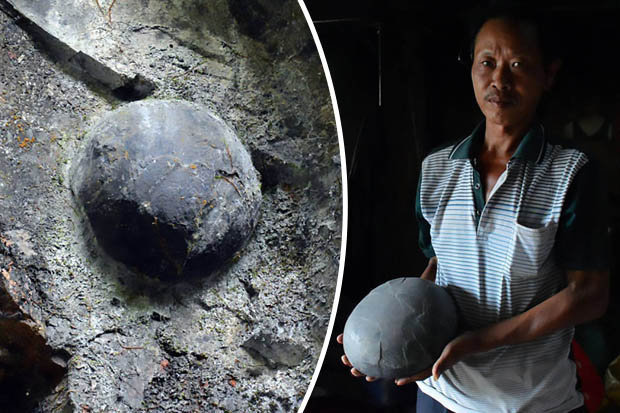
This cliff stands 2.4 meters tall and stretches 19 meters long, looking like most other cliffs. What’s weird is the smooth, round bumps of various sizes that stick out from its rough surface. Over time, these “stone eggs” grow bigger until they can no longer cling to the cliff and fall off, making room for new ones to form.
According to villagers from nearby Gulu, Chan Da Ya takes 30 years to “lay” these strange stone eggs.
Every 30 years, Chan Da Ya produces many of these “eggs,” surprising locals and scientists alike.
Scientists have only partially unraveled this mystery.
This egg-laying phenomenon is considered one of a kind worldwide, attracting attention from geologists, archaeologists, and researchers. Many have traveled to study the cliff in hopes of finding a convincing explanation.
Tests show that most of Mount Gandeng is made of softer limestone sediment that erodes easily. The smooth, round bumps are made of a much harder type of rock. The difference in erosion rates might explain this strange formation.
However, scientists admit this only solves part of the puzzle. They still can’t explain why the stones have such perfect round shapes and smooth surfaces.
Because of its mystery, locals believe that anyone who finds a stone egg fallen from Chan Da Ya will be very lucky.
People often visit the cliff to touch the “stone eggs” and wish for good luck.
Generations of Gulu villagers have known about the egg-laying cliff and regularly visit to touch the “magic eggs” for luck. Data from 2005 shows that most of the 125 families in Gulu keep at least one of these mysterious stones at home as a lucky charm.
In recent years, Chan Da Ya has become a tourist attraction. Unfortunately, many stone eggs have been stolen and sold by greedy treasure hunters. Only about 70 eggs remain, carefully protected by locals. Any new eggs about to fall are often stolen by treasure seekers.

