

Before we dive into this question, let’s check out some photos of chimpanzees at the zoo to see if their muscles really are that impressive.
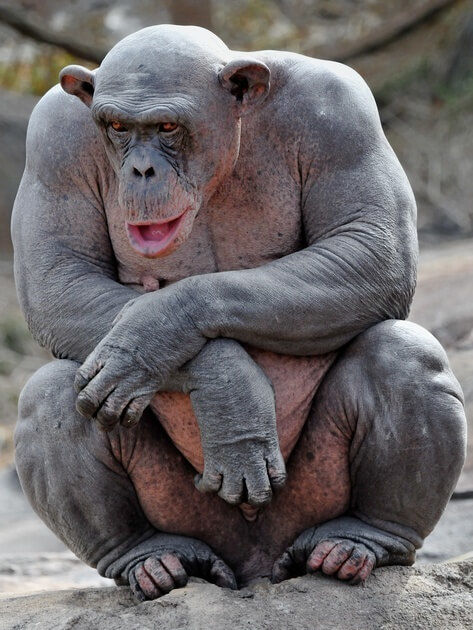
Here’s a female chimpanzee at the zoo.
And here’s a male chimpanzee at the zoo.
We all know that animals kept in zoos have much less space to move around compared to their wild counterparts, but from these two photos, you can see that even with less activity than wild chimps, they still have bulging muscles just like people who hit the gym daily.
The truth is, many strong land animals don’t actually move around much during the day and don’t seem to bother with intense workouts like humans do. Lions sleep nearly 20 hours a day, hippos spend most of their time soaking in water and only slowly walk on land at night to feed. Elephants, wild buffalo, orangutans, and other herbivores spend their days eating and never train like humans.
When they’re not eating, they rest to save energy for hunting, escaping predators, or fighting. Yet their muscles remain highly developed, and they obviously have great physical strength. We know that humans, even with intense training to build muscle, will lose muscle mass and gain fat if they stop exercising for a while.
To keep muscles, fitness, and peak strength, humans need regular, uninterrupted exercise. This is especially true for professional bodybuilders and strength or endurance athletes.
But sometimes there are exceptions in humans. Around 2000, a newborn boy in a German hospital immediately caught doctors’ attention.
The left photo shows the baby at birth, and the right one at 7 months old. Ultrasound confirmed that the arrows point to muscle tissue. By age 4 and a half, this boy could lift a 3kg weight with both hands. His muscles were twice as developed as other kids his age, while his body fat was half as much. His mother was a professional sprinter with strong muscles, and his brothers, father, and grandfather were all healthy and strong. His grandfather was a construction worker who could lift 150kg stones by hand.
The boy’s doctor, Schuelke, suspected a link to Myostatin syndrome, also known as growth and differentiation factor 8 (GDF-8). This syndrome was first discovered by geneticist Dr. Se-Jin Lee at Johns Hopkins University in a 1997 mouse study.
When the gene producing GDF-8 protein is removed, mice develop huge muscles, double the muscle mass of normal mice. In 2007, Lee found that another protein, follistatin, also affects muscle growth. Genetically modified mice lacking myostatin and with increased follistatin had muscle growth four times greater than normal mice.
Schuelke tested the boy and his mother’s myostatin genes for mutations. Among the alleles, only one of the mother’s genes was abnormal, but the boy had two mutated gene copies, meaning he couldn’t produce myostatin. This genetic mutation reduced the factors that inhibit muscle growth, so the boy developed stronger muscles than average.
Animals in the wild can also have GDF-8 mutations. When humans noticed unusually muscular livestock, they bred them for stable inherited traits, like the Belgian Blue cattle breed. This mutation causes myostatin deficiency and speeds up muscle growth in these cows.
Now, back to our original question: why do gorillas, chimpanzees, and kangaroos have such huge muscles without training?
Research shows muscle growth is controlled by over a dozen genes and many proteins in the body. Different individuals develop muscles differently. For example, with the same workout and diet, some people build muscle quickly and noticeably, while others don’t. So the genetic differences between humans and animals are huge and determine their muscle development.
Survival competition in nature is brutal, so most animals evolve survival mechanisms and competitive strategies unique to their species, and muscle development is part of that. More muscle means higher energy consumption.
Humans, despite having less muscle and a more fragile body, consume a lot of energy to keep their bodies running, over 400 calories more than chimpanzees, 635 more than gorillas, and 820 more than orangutans.
The human brain uses a huge amount of energy, though it’s only 2.5% of body weight, it consumes 20% of resting energy. If humans had muscles like animals, constantly eating or resting all day wouldn’t fit with our ancestors’ hunter-gatherer lifestyle.
Evolution led humans to give up massive muscle growth in favor of a sturdy body structure, strong cardiovascular systems, faster metabolism, smarter brains, better endurance, and agility. We don’t fully understand how this process happened or the exact mechanisms, but this balanced survival strategy helped humans become the strongest species on Earth.

