

Typically, incandescent bulbs last between 1,000 and 2,000 hours. Even LED bulbs, which are much more durable, usually last between 25,000 and 50,000 hours.
But hanging from the ceiling of the Livermore Fire Department in California is the longest-lasting light bulb in the world, with a lifespan of over 120 years. What’s even more remarkable is that this incredible longevity belongs to an incandescent bulb, not some special new technology.
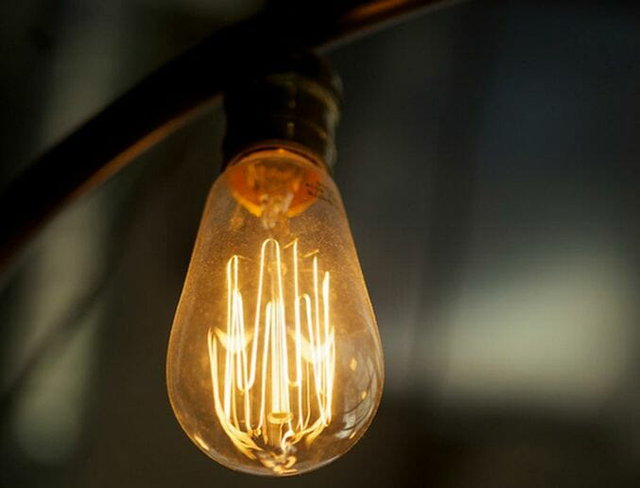
Despite existing for so long, the bulb’s impressive lifespan only caught public attention in 1972, when a fire station employee mentioned to a local paper that the round bulb had been continuously lit for many years with no one knowing its origin. Mike Dunstan, a young reporter for the Tri-Valley Herald, began investigating and was amazed by what he found.
It turns out the bulb has been glowing almost nonstop for over a century, only being turned off a few times briefly, once when it was moved in 1903, again for about a week in 1937, and once more in 1976 during another relocation. In recent years, it has gone out a few times due to short power outages on its dedicated circuit.
Since then, this special bulb has drawn widespread attention. The Guinness World Records officially recognizes this 30-watt bulb as the “longest-lasting light bulb in the world.” It has been featured in numerous major news outlets and TV programs.
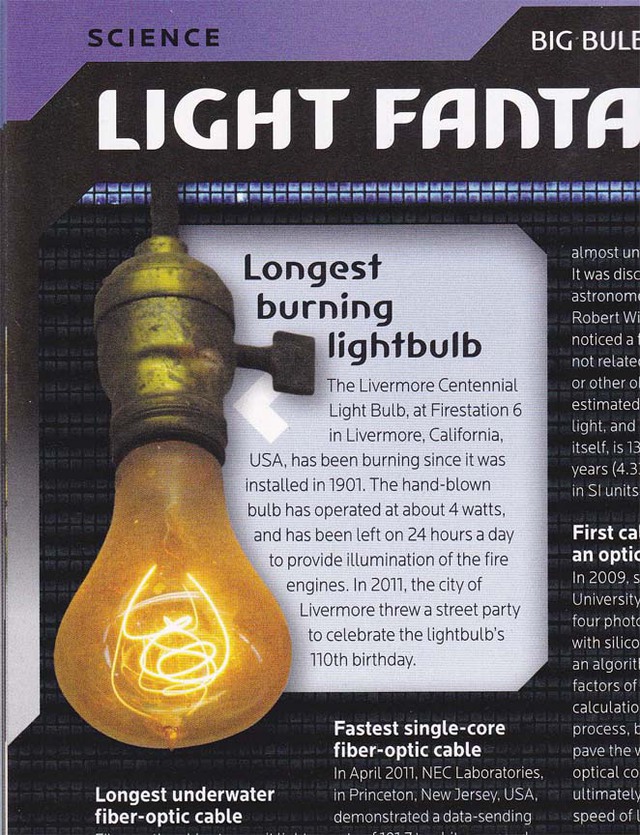
In 1976, when the bulb was moved to its new home at Livermore Fire Station No. 6, a crowd of police officers and firefighters eagerly waited to see if it would light up again. Fire department deputy chief Tom Brandall recalled, “The city electrician installed the bulb and connected the power. For about 22 to 23 minutes, the bulb didn’t light. The crowd held their breath. Then the electrician shook the switch hard and it lit up again.”
Since then, the bulb has been continuously monitored by cameras to ensure it stays lit. In fact, a live stream called “BulbCam” was launched so people could watch it in real time. On Facebook, there are over 9,000 groups dedicated to this bulb.
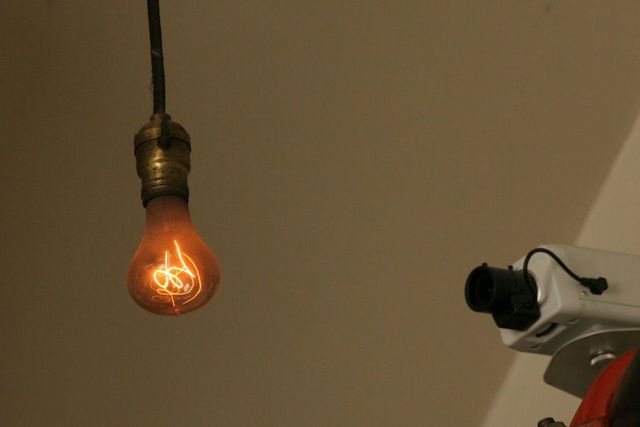
Despite its long life, the bulb was never known for brightness, in its early days, it was about as bright as a 60-watt bulb, but now it only shines as brightly as a 4-watt bulb. However, this drawback is balanced by its unique design.
Master designer Adolphe A. Chaillet created this bulb, which was produced by his company, Shelby Electric Company. Its special feature is a carbon filament, which helps the bulb last longer and emit less heat than Edison’s tungsten filament bulbs. Still, this doesn’t fully explain its extraordinary lifespan.
Many research groups, from the Mythbusters team to NPR, have tried to explain the bulb’s incredible longevity. But so far, all efforts have only deepened the mystery.
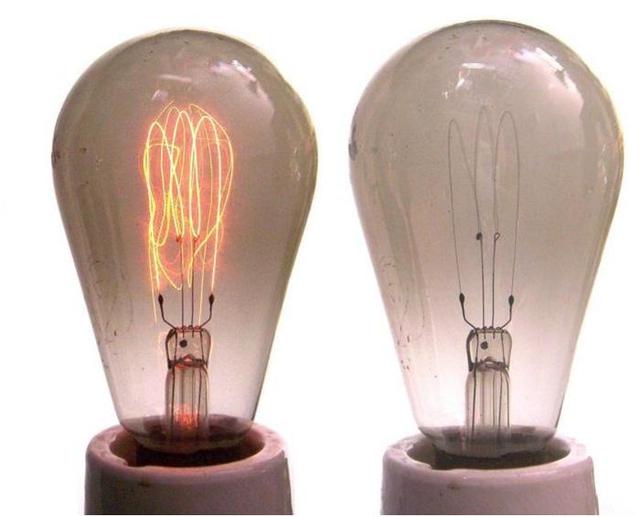
In 2007, physics professor Debora M. Katz managed to acquire a Shelby bulb similar to the century-old one and discovered its filament was eight times thicker than those in modern incandescent bulbs.
“I compared it to the width of modern bulb filaments. Modern filaments are coils about 0.08mm in diameter, made from wire 0.01mm thick. I didn’t realize this until I looked under a microscope. The filament in the 100-year-old Shelby bulb is as thick as the entire coil in a modern bulb, about 0.08mm,” she explained.
Katz believes the thicker filament may be why the bulb lasts so long. She also suggests its longevity is partly because it has been kept on continuously, rather than being switched on and off daily, which stresses filaments by heating and cooling.
But ultimately, Katz and her students couldn’t pinpoint exactly what makes this bulb so durable. Justin Felgar, one of her students, said that to truly understand it, the bulb would need to be “taken apart and run through the U.S. Naval Academy’s particle accelerator”, a costly process that hasn’t happened yet, as long as the bulb keeps shining.
Compiled from various sources

