

One big reason people trust the Pi Network project and actively mine its Pi Coin is the impressive profiles of its founders. Especially notable is the project’s technical lead, Dr. Nicolas Kokkalis, who’s often called the “soul” of Pi Network.
That’s because Dr. Kokkalis has a seriously strong tech background from Stanford University. According to his bio on Pi Network’s official site (minepi.com), early in his doctoral work, he created a framework for writing “smart contracts” on fault-tolerant distributed systems, years before blockchain and Ethereum even existed.
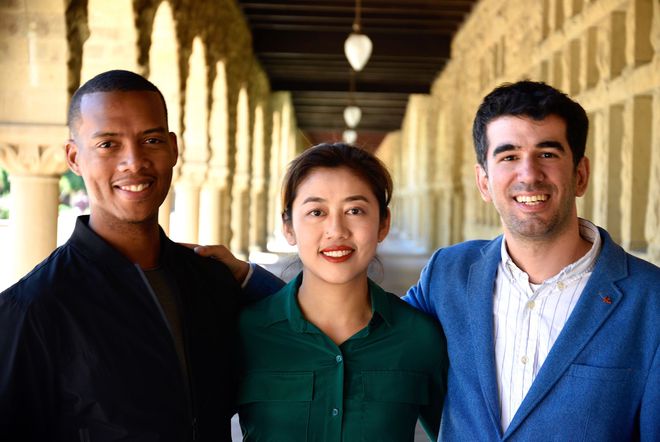
The three founders of Pi Network are Dr. Nicolas Kokkalis (technical lead, right), Dr. Chengdiao Fan (product lead, center), and Vincent McPhillip (community lead, left).
Besides that, Kokkalis also created the online gaming platform Gameyola and StartX, a startup accelerator at Stanford from 2010 to 2018, before diving into Pi Network, a crypto and peer-to-peer project he claims to have given his “100% professional commitment” to, while his “beloved wife and son” get his “100% personal commitment.”
The “Father” Who Doesn’t Mention His “Child”
But here’s the shocker: a project that supposedly has Kokkalis’ full professional dedication is nowhere to be found on his LinkedIn profile, the world’s top professional network with over 200 million members. This is especially odd for a PhD scientist like him. Meanwhile, less important projects like Gameyola and StartX are listed on his LinkedIn.
If Kokkalis truly founded Pi Network and committed 100% of his career to it, how could he forget to mention it on his most important professional profile?
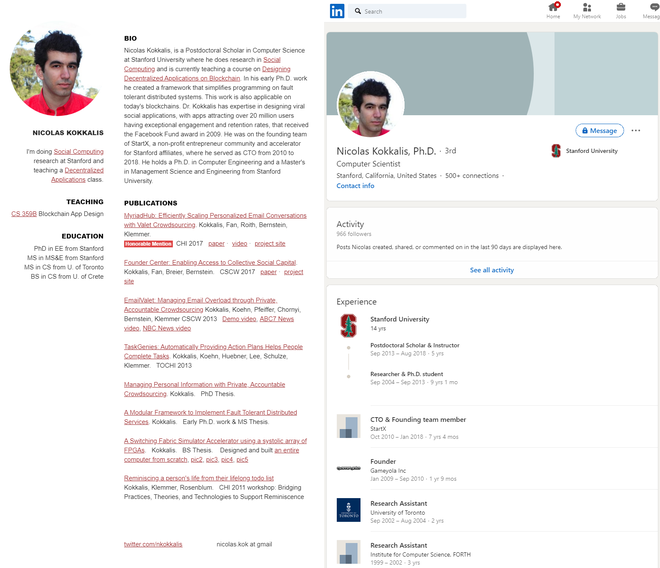
If Kokkalis’ LinkedIn isn’t convincing enough (after all, it’s an online profile!), look at his achievements posted by Stanford, where he studied and worked. Just like on LinkedIn, his work with Gameyola and StartX is highlighted, but there’s not a single word about Pi Network.
Another curious detail: Kokkalis’ Stanford bio links to his Twitter account at twitter.com/nkokkalis. That account was created in October 2008 but last tweeted in early 2013. Just like his LinkedIn and Stanford profiles, it never mentions Pi Network or its technology.
In contrast, there’s another Twitter account at twitter.com/drkokkalis, which uses his avatar but features a banner and tweets mostly about Pi Network. One tweet from this account even links back to the nkokkalis account, calling it his old profile.
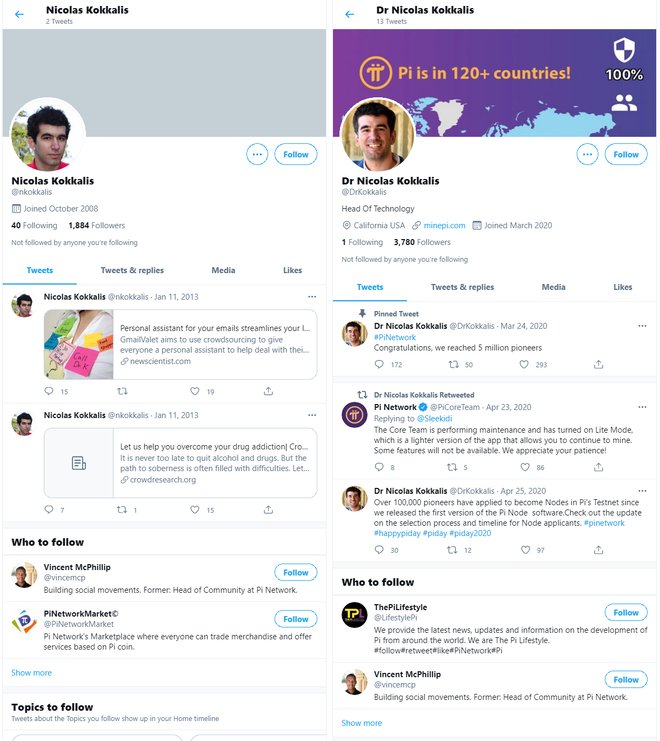
However, this drkokkalis account was only created recently, in March 2020, and its last tweet was in April 2020, just over a month after it was set up.
Also, this account was created more than a year after Pi Network first launched. The Pi Network app appeared on Google Play Store in December 2018, while the project officially launched on March 14, 2020.
This raises a red flag: if Kokkalis is really the passionate “father” of Pi Network, why would he neglect his social media presence and fail to update anything about the project for so long?
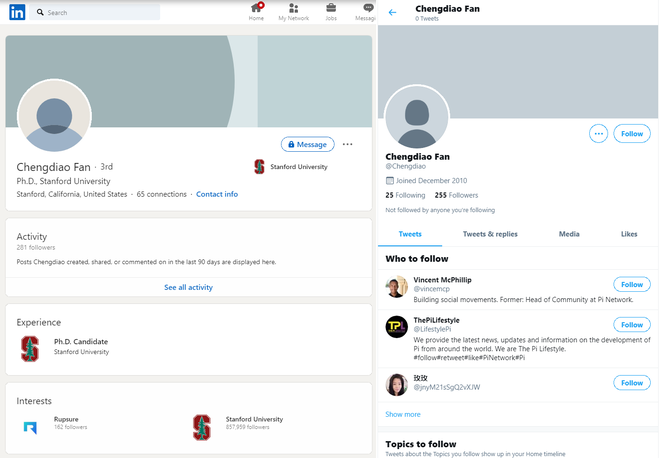
Besides the technical lead, Pi Network also lists Dr. Chengdiao Fan as product lead. There aren’t many achievements listed for her, but like Kokkalis, her LinkedIn profile doesn’t mention Pi Network at all.
A Twitter account under her name, created in 2010, also has no tweets or info about Pi Network.
The Most Dedicated Founder Has Left the Project
The third founder is Vincent McPhillip, the community lead. Unlike the other two, McPhillip actively posted about Pi Network on both LinkedIn and Twitter. However, his LinkedIn now lists him only as the “former community lead”.
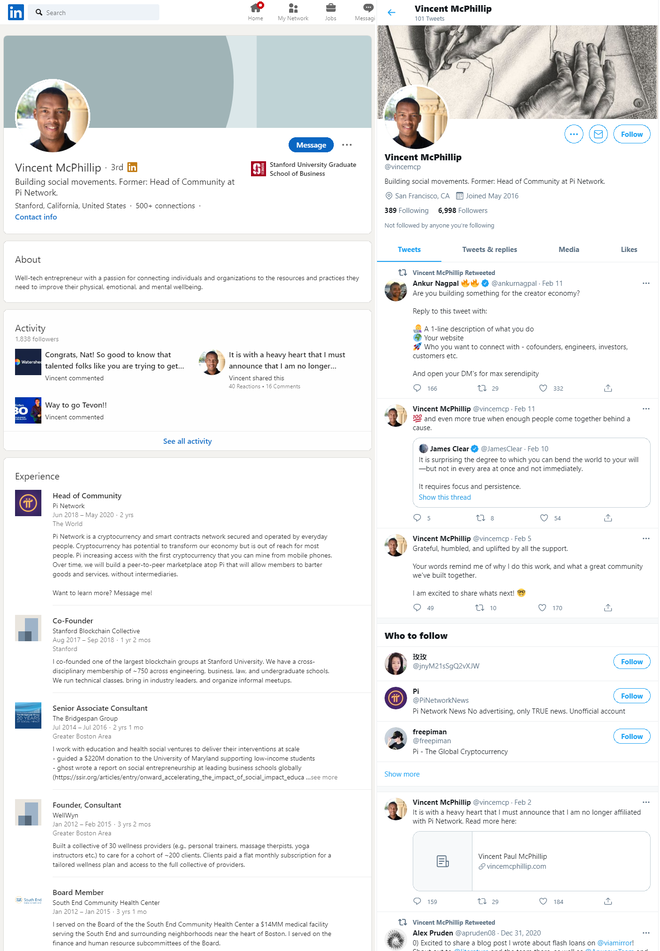
On Pi Network’s official website, Vincent McPhillip’s name is nowhere to be found on the team page.
Beyond some loose social media links between the three founders, the only real evidence of their connection is a group photo of them together, a meaningless snapshot that doesn’t prove their actual contributions to building this globally known project.
It’s hard to believe that the founders of a major crypto project like Pi Network would have such strange profiles. This fuels doubts about whether they truly founded or even participated in the project. How trustworthy can Pi Network be if two of its three founders don’t even mention it on their professional profiles?

