

A quantum internet promises to be way faster and much more secure than the internet you’re using right now. And recently, scientists have taken a big step closer to making that a reality. They used quantum teleportation to send information over a long distance with higher accuracy than ever before.
Scientifically, this is based on a phenomenon called quantum entanglement. It sounds like sci-fi, but it’s a real effect in quantum mechanics. Basically, two or more particles become linked so tightly that changing the state of one instantly changes the state of the others, no matter how far apart they are.
This process, which Einstein famously called “spooky action at a distance,” can be harnessed to build quantum networks. Pairs of photons can be entangled and separated, allowing data to be “teleported” between them across long distances. One big advantage is security. Anyone trying to eavesdrop on the data can’t do so without disturbing the quantum system, which immediately reveals the intrusion.
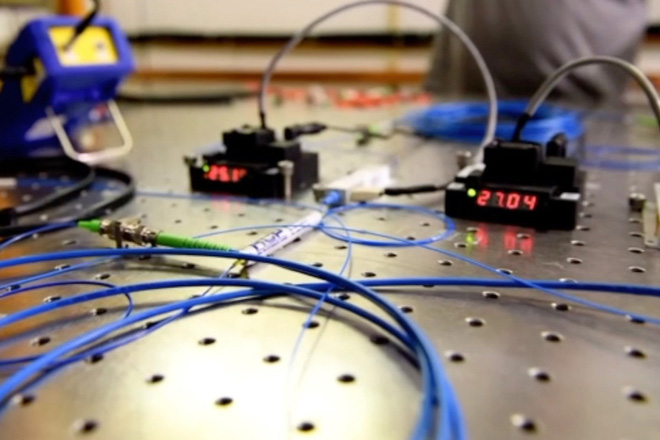
Recently, researchers from Fermilab, AT&T, Caltech, Harvard, NASA JPL, and the University of Calgary demonstrated stable and highly accurate quantum teleportation over a long distance. They sent information across 44 km with over 90% fidelity, setting a new record for that distance.
To do this, the team added a third “node” between the sender and receiver. To transfer info from A to B, both sides first send a photon to C. The receiver B sends one half of an entangled pair and keeps the other half. When photons from A and B meet at C, they become entangled, allowing information from A’s photon to be transferred to both photons held by B. Essentially, it’s like teleporting information from A to B.
This isn’t the longest distance quantum teleportation has achieved. In 2015, data was teleported over fiber optic cables for more than 100 km, and in 2017, Chinese scientists broke records by teleporting data over 1,200 km using a satellite as a relay.
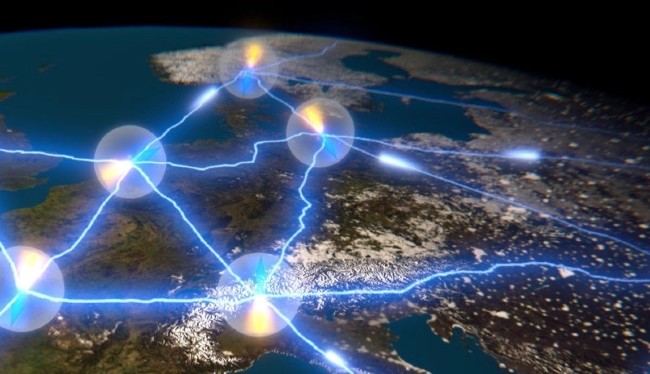
But compared to previous experiments, this latest result marks a breakthrough in accuracy over long distances at 90%. For example, the 100 km record had about 80% fidelity, and the 1,200 km record was around 0.869 ± 0.085. The researchers also noted that their setup mainly used off-the-shelf components, meaning a future quantum internet could be built using existing infrastructure.
The study was published in the journal PRX Quantum.
Source: newatlas

