

Recently, Chia has become one of the hottest cryptocurrencies in China. Unlike ETH, which requires users to mine with GPUs, this so-called ‘green Bitcoin’ lets users mine by using free space on storage devices like HDDs or SSDs.
Specifically, Chia mining demands a large amount of free storage space because its mining software performs many read/write operations. Simply put, the more free space on your hard drive, the more you can earn. Recognizing this demand, Chinese hardware manufacturers quickly released specialized SSDs designed for Chia miners.
Most recently, motherboard maker Onda unveiled a board specifically for mining this coin. With a design that’s been called quite unusual, Onda’s new model, the B365 D32-D4 Magic Edition, features 32 SATA ports, allowing users to connect up to 32 storage devices (HDDs or SSDs) simultaneously.
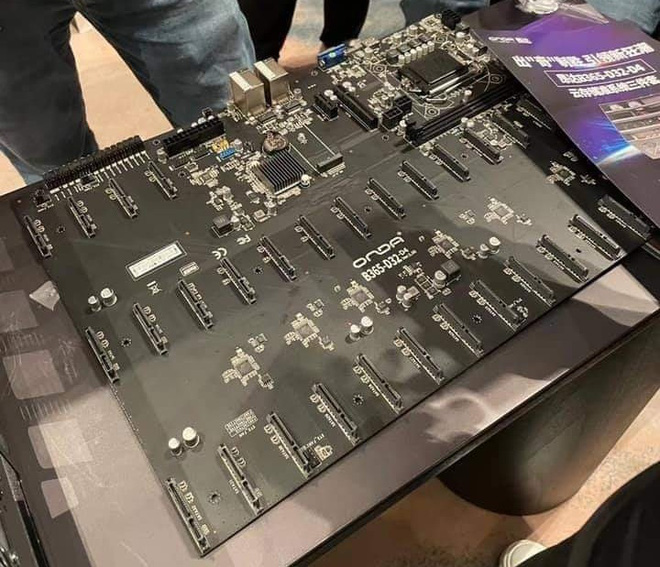
According to Wccftech, the Onda B365 D32-D4 Magic Edition is built on the Intel B365 chipset and includes four DDR4 slots, one PCIe Gen 3.0 x16 slot, and a single PCIe 3.0 x1 slot. To fit 32 SATA ports, this motherboard is twice the size of a standard m-ATX board (244mm x 244mm), measuring 530mm x 310mm. Onda details that the board has six 6-pin power connectors to supply the SATA ports. These ports support up to 448 TB of storage across HDDs or NVMe SSDs. This means Chia miners can connect 32 HDDs with 14TB capacity each at once.
Wccftech expects this motherboard to sell very well as Chia mining gains popularity in the Asia-Pacific region. Data from Tomshardware shows that high-capacity HDDs (16, 18TB) from Seagate and Western Digital are consistently sold out in China. Prices for these drives have also surged dramatically, rising as much as 66.4% before the Chia mining craze took off.
Source: Wccftech

