

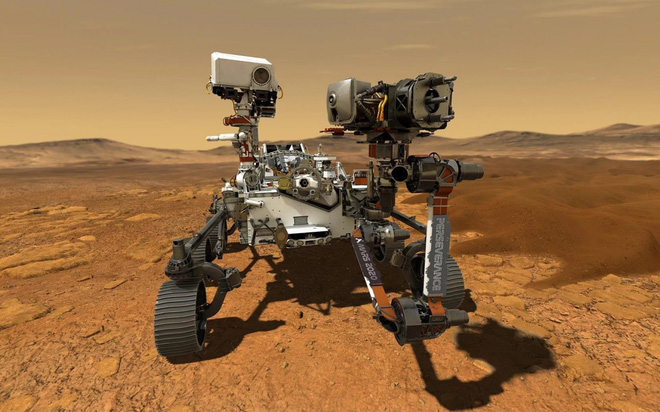
Over a month ago, NASA’s Perseverance rover landed on Mars. But its real work is just beginning. Deep inside Perseverance is a device designed to pull Mars’ carbon dioxide-rich atmosphere and turn it into oxygen. Basically, it’s like a mechanical tree, something that could shape humanity’s future on the Red Planet.
Mars’ atmosphere is only about 1% as dense as Earth’s. If we want to live and work there, we’ll definitely need to produce and store a lot more oxygen.
“What breathes the most on a Mars mission? It’s not humans” said Michael Hecht, deputy director of research management at MIT’s Haystack Observatory and lead investigator on NASA’s MOXIE project. “It’s the rocket that will take you from Mars back home, the thing that gets you off the planet.”
NASA estimates a crew of four would need a huge amount of rocket fuel, about 6.8 tons of fuel and nearly 25 tons of oxygen, to generate enough thrust to leave Mars and return home. Obviously, bringing that much oxygen from Earth to Mars ahead of time is impossible.
That’s why NASA developed the Mars Oxygen In-Situ Resource Utilization Experiment, or MOXIE.
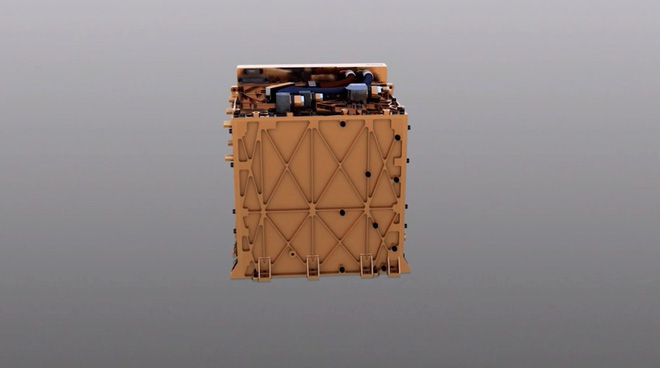
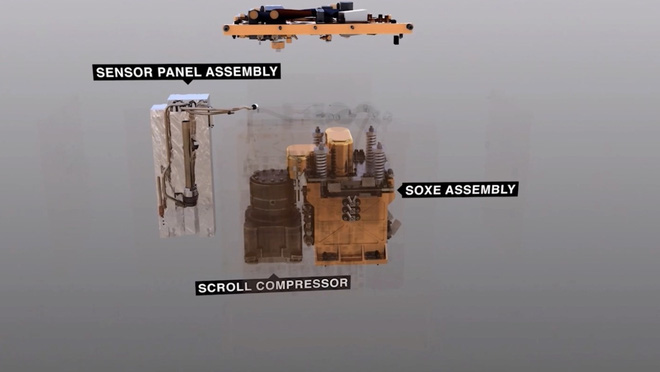
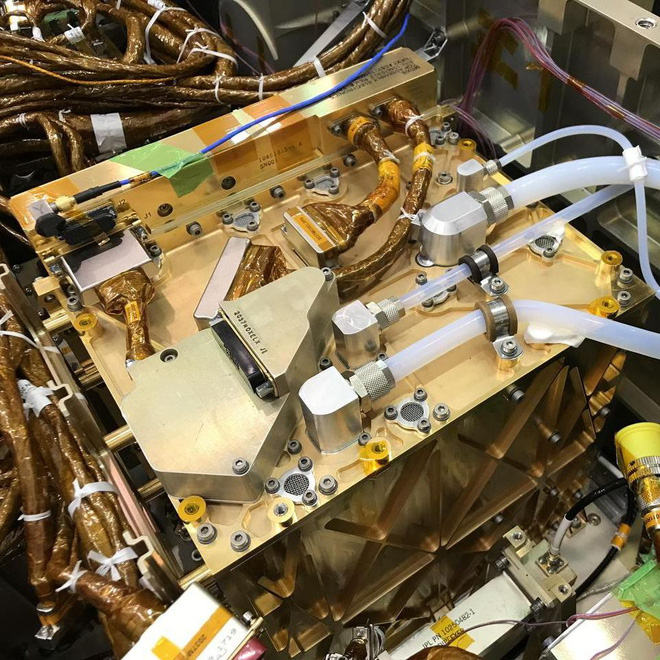
About the size of a car battery, MOXIE is one of NASA’s many In-Situ Resource Utilization (ISRU) experiments and the first tested in space. ISRU experiments aim to find ways future astronauts can produce essential materials from resources available on other worlds.
“If we really want to leave the planet and do more than just science experiments, you have to think about using local resources” said Jerry Sanders, head of ISRU Capability Leadership at NASA’s Johnson Space Center in Houston.
NASA is investing time and a lot of money, about $50 million for MOXIE, to develop strategies that could support self-sustaining settlements on the Moon and Mars.
After years of research, we’re about to find out if MOXIE and similar experiments really work.
How MOXIE Works
MOXIE uses a process called solid oxide electrolysis. First, a filter and pump draw in Mars’ carbon dioxide and compress it to Earth sea-level pressure. This compressed CO2 is then fed into a solid oxide electrolysis stack made up of 10 cells.
“The electrolysis system is the heart of MOXIE” said Asad Aboonbaker, a MOXIE collaborator and systems engineer at NASA’s Jet Propulsion Laboratory in Pasadena.
The stack consists of layers of metal and specialized ceramic cells that use oxygen ions to generate electricity when heated to high temperatures. “With the right voltage, you can selectively move oxygen ions through the ceramic membrane and separate them from everything else” Aboonbaker explained.
The result? Pure oxygen gas.
MOXIE is a sophisticated system. Carbon dioxide goes in. Oxygen and carbon monoxide, a harmless byproduct, come out. If too much electricity is applied, the system can produce carbon (soot) instead of carbon monoxide. If the voltage is too low, excess carbon monoxide can flood the system and start oxidizing the equipment.
“We have to find the sweet spot between these two scenarios” he said.
Scaling Up
Right now, MOXIE is just a demonstration technology. Hecht estimates it will run for about 10 hours over the next few years. Every two hours of operation produces roughly 6 to 10 grams of oxygen, enough to keep a small dog alive.
If MOXIE succeeds in producing oxygen for Mars missions, the next step is scaling up. That means building a bigger compressor and expanding the electrolysis stacks to 100 units, according to Hecht. The system’s design means that increasing size and number of stacks will increase oxygen output.
A large-scale MOXIE designed to produce oxygen for a crew of four would need to run about 10,000 hours at an average output of 2 to 3 kilograms of oxygen per hour.
But “scaling up” the current MOXIE design to produce enough oxygen for a small crew is just one small step toward a sustainable future on Mars. There are major challenges to solve, like Mars’ weather.
On any given day, Mars’ surface temperature can swing by over 65 degrees Celsius. Massive dust storms can cover the entire planet for months, blocking sunlight and increasing atmospheric pressure by up to 12%.
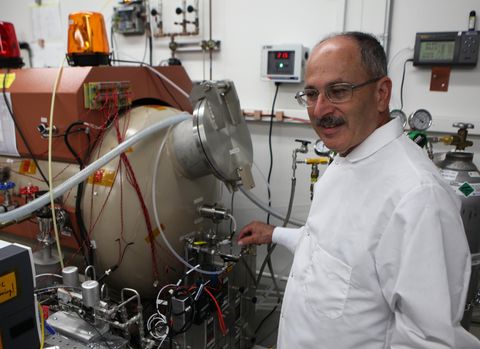
“Weather affects how MOXIE operates” Hecht said. Understanding how harsh storms and significant pressure changes impact the mechanical systems can help design the right large-scale setups. For example, if a future large MOXIE system faces high pressure, Hecht says it could slow the compressor to reduce CO2 intake.
Mars’ surface atmospheric pressure is about 4.5 Torr. At the summit of Olympus Mons, the largest volcano on Mars, pressure drops to around 0.2 Torr, in the deepest part of Hellas Planitia, it rises to about 8.7 Torr. For comparison, Earth’s surface pressure is about 760 Torr.
“We designed this system to be tough and flexible enough to operate across a wide range of atmospheric conditions” Aboonbaker explained. MOXIE can function in pressures from 2 to 12 Torr.
It will be tested day and night, as the air cools and becomes denser. Since atmospheric pressure can vary by up to 30% between summer and winter months, testing will run year-round. Built-in sensors will monitor MOXIE’s performance during each run and report any issues.
Data from these sensors will help design future large-scale systems capable of producing oxygen continuously, no matter the weather.
NASA estimates the first Mars crew will need about 30 kilowatts daily to support overall life support. A large MOXIE system would use a similar amount of power. While solar panels seem the obvious choice for powering a Mars settlement, they have drawbacks.
First, you’d need a lot of solar panels to generate enough power for a crewed mission. Mars’ day-night cycle and dust storms that block sunlight mean any solar-powered settlement would also need a reliable energy storage system.
The best solution, according to Aboonbaker, is a small nuclear power plant. “It’s a reasonably sized reactor to power things like a human-scale MOXIE” he added.
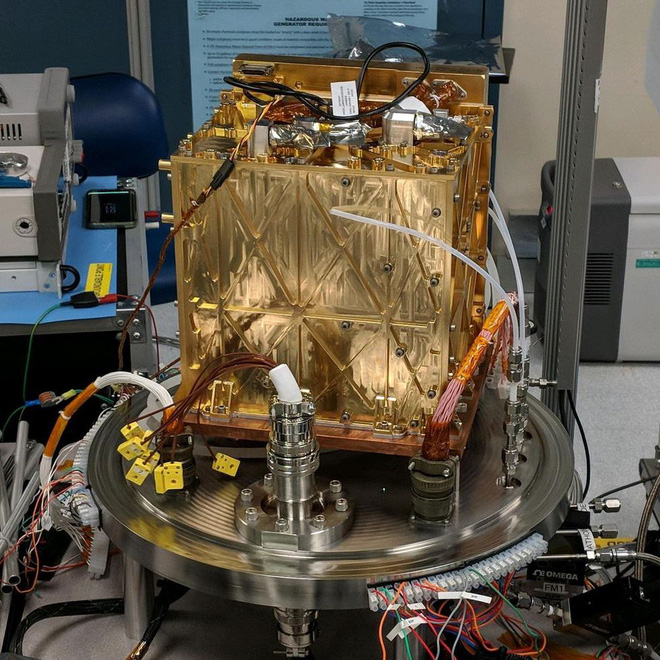
Nuclear engineer Dave Poston from Los Alamos National Laboratory agrees. It’s an efficient and safe alternative to solar power: a single reactor could replace a solar array nearly the size of a football field. You’d get “more energy per kilogram than traditional solar power systems” he said.
This technology isn’t brand new. Between November 2017 and March 2018, NASA, the National Nuclear Security Administration (NNSA), Los Alamos National Laboratory, and partners tested a fission reactor called Kilopower Reactor Using Stirling Technology, or KRUSTY.
Located in Nevada’s desert, this reactor successfully generated 5 kilowatts of electricity, about half the power needed to light a home. Last year, Los Alamos National Laboratory licensed the reactor technology to Poston and fellow nuclear engineer Patrick McClure.
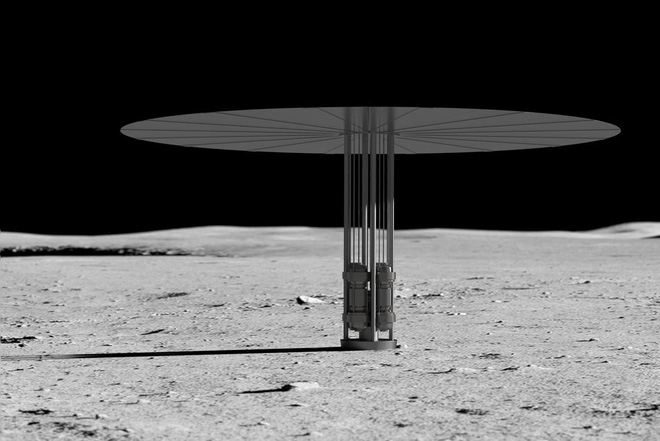
According to McClure, the best way to test this tech in space is sending a rover equipped with 10-kilowatt reactors to Mars. That’s enough power to support a six-person crew for a day on Mars.
Future larger Kilopower systems could generate megawatts of power to support bigger communities. Instead of being attached to landers, Poston says these reactors could be buried underground or placed half a mile from settlements to avoid damage during launch.
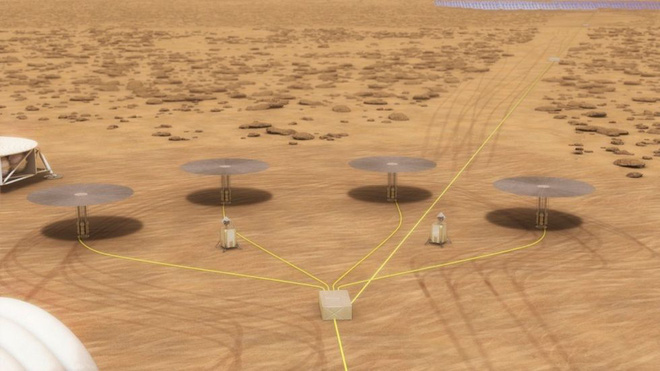
Poston believes Kilopower could be ready to launch within the next decade. “The challenge isn’t building the reactor, we can do that pretty quickly” McClure said. “The challenge is finding someone with the right launch vehicle and equipment to land it safely.”
The Storage Challenge
Next up is storage. “Storage methods exist, but like any engineering on other planets, it can be frustrating” Hecht said. “Knowing how to do it and actually doing it are two different things.”
Liquid oxygen for rocket fuel is especially tricky to store on Mars. It must be cooled to about -182 degrees Celsius, a process that, according to Sanders, requires ten times more energy than just storing it.
Keeping tanks cold enough to prevent oxygen from warming and evaporating is critical. Designing insulated cryogenic tanks for Mars is a whole different challenge than designing them for weightless space environments.
“In space, the vacuum environment makes insulation highly effective” Sanders said. “But Mars has an atmosphere, so all the insulation tech we developed for space doesn’t really work there.”
A temporary solution is sending steel tanks wrapped in vacuum jackets, similar to those used on Earth for cryogenic liquids. “You basically put one tank inside another and pump out the air between them to create a vacuum” Sanders explained. “This vacuum reduces heat transfer into the inner tank holding the cryogenic liquid“. But these options are bulky and costly to launch to Mars. Aerogels, ultra-light silica materials, could be used to insulate metal tanks and help reduce weight.
“Mars has an atmosphere, so all the insulation tech we developed for space doesn’t really work there”
Sanders says NASA is also exploring inflatable tanks that can be folded for launch and inflated on Mars. While these save fuel, space, and cost, they’re less efficient at thermal insulation. “It’s probably a trade-off we’ll have to consider” he said.
Then there’s dust. “When you have a dust-covered surface, its thermal properties change” Sanders said. Like how dust on ice caps absorbs heat and speeds melting, a layer of Martian dust on cryogenic tanks could cause them to warm.
NASA’s Kennedy Space Center team is developing electrostatic dust removal tech designed to push lunar or Martian dust off surfaces. Periodic bursts of compressed air could also help clear dust. A simpler solution? Build tanks with pointed tops so gravity helps dust slide off, Sanders said.
Initially, tank sizes will be limited by the size of the landers that carry them. But NASA is already thinking bigger, like building gas stations on Mars where future settlers can refuel their rockets.
Continuing the Work
While MOXIE is busy “breathing” oxygen on Mars, engineering teams on Earth continue developing human-scale systems.
Hecht and his team are working with Colorado company Air Squared to build a larger compressor. Another company, OxEon Energy in Salt Lake City, recently received major NASA funding to develop a large stacked solid oxide electrolysis structure capable of producing nearly 1 kilogram of oxygen per hour. At MIT, researchers are developing smaller, lighter filters to keep dust out.
Hecht believes a full-scale MOXIE system could be on Mars within the next two decades. That depends on government priorities and funding. “If you ask ‘When will we do it?’ the answer depends more on politics than science” he said. “I believe we can do it by 2030 if we’re ambitious and serious about it.”
The key to a successful settlement future is setting everything up within one cycle, about 26 months, before humans arrive on Mars. “That’s the time we need to fill these oxygen tanks” Hecht explained. “You start as soon as the system arrives and want to finish just in time to tell everyone on Earth the tanks are full.”
As a small-scale project the size of a car battery, scientists hope MOXIE’s results will be well worth it and pave the way for future colonization success.
Source: Popular Mechanics

