

Every time a cell in your body regenerates, ironically, a bit of your youth slips away. This happens because the ends of your chromosomes, called telomeres, get shorter.
With each cell division, your telomeres shrink a little. This shortening happens at a steady rate across all cell types and can be standardized across the population. Scientists consider telomeres as a biological clock that tracks your true biological age, not just your calendar age.
Reversing telomere shortening could essentially reverse cellular aging and help you regain your youth. Previous studies have shown that people who exercise regularly can rejuvenate their bodies by up to nine years through telomere extension.
But is there a faster, more effective way to do this?
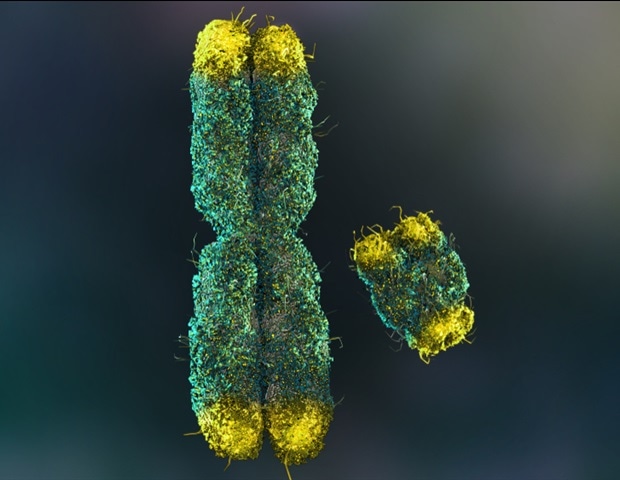
These chromosome ends are called telomeres.
A team of Israeli scientists recently announced they found a way to reverse telomere shortening in a small study with 35 volunteers. These volunteers underwent a three-month course of hyperbaric oxygen therapy.
Five times a week, they spent 90 minutes inside a high-pressure pure oxygen chamber. This treatment extended their cellular telomeres by 20%.
Dr. Shair Efrati, lead researcher from the Sagol School of Neuroscience at Tel Aviv University, said reversing telomere shortening is the holy grail of aging biology and human longevity research. Israel is determined to lead the way in this field.
Telomeres and Human Longevity
“After NASA’s twin study, where one twin went to space and the other stayed on Earth, significant differences in their telomere lengths were observed,” Dr. Efrati explained. “We realized that external environmental changes can affect the cell nucleus and are closely linked to aging.”
Telomeres are repeating DNA sequences at the ends of chromosomes, like the plastic tips on shoelaces. They replicate alongside the rest of the chromosome each time a cell divides. However, with every replication, a small part of the telomere fails to copy, causing chromosomes to get shorter.
Anyone who’s lost the plastic tip on a shoelace knows it soon frays and becomes unusable. Similarly, shorter telomeres make chromosomes more prone to mutations.
These mutations coincide with changes that cause many age-related diseases, especially cancer. While it doesn’t prove we age because our telomeres shorten, there’s definitely a link between telomere length and health that researchers want to explore further.
“Longer telomeres correlate with better cell performance,” Dr. Efrati said.
Dr. Shair Efrati, lead researcher from the Sagol School of Neuroscience at Tel Aviv University.
Many factors speed up telomere erosion. Lack of sleep, eating too much processed food, and even having many children are among them.
On the flip side, slowing telomere shortening takes more effort. Regular exercise and a balanced diet are two effective ways to keep your chromosomes strong for as long as possible.
But is there an easier way? Dr. Efrati and his colleagues at Tel Aviv University recently tested a therapy called hyperbaric oxygen therapy (HBOT) on 35 volunteers and found they regained about 20% of their lost telomere length.
That’s a huge improvement compared to other anti-aging treatments, which typically only preserve 2-3% of telomere length.
The Youth-Boosting Oxygen Chambers
HBOT has been used before to treat divers with decompression sickness and patients with oxygen-sensitive bacterial infections. It involves sitting in a chamber filled with pure oxygen at pressures higher than normal atmospheric pressure.
In Dr. Efrati’s study, volunteers sat in the chamber five times a week for 90 minutes each session. They completed a total of 60 sessions over three months.
Inside a hyperbaric oxygen chamber.
This high-pressure oxygen environment is known to trigger a range of genetic and molecular changes. The study showed these changes reversed telomere loss and positively impacted cellular health.
Blood tests from the volunteers also revealed that this oxygen-rich environment helped maintain T-cell density in their blood, a key marker of immune system aging, which also slowed down.
Overall, researchers reported that 11-37% of the volunteers’ cells were rejuvenated, with telomeres lengthening between 20-38%.
“Today, telomere shortening is considered the holy grail in aging biology. Researchers worldwide are working on drug and environmental interventions to extend telomeres,” Dr. Efrati said.
“Now, we have demonstrated anti-aging effects in our study group using HBOT. Further research is needed to optimize this protocol for individuals.”
Published in the journal Aging, the authors noted this is just one of several clinical trials in Israel’s comprehensive program treating aging as a disease that can be cured or reversed.
“With this pioneering study, we have opened the door to deeper investigations into HBOT’s impact on cells and its potential to reverse aging,” the researchers concluded.
Sources: ScienceAlert, ScienceDaily

