

Last month, an article titled “The Bitcoin Clean Energy Initiative” challenged the long-held belief that Bitcoin mining seriously harms the environment and damages the planet. The article argued that Bitcoin mining could actually encourage more use of renewable energy instead of carbon-emitting fossil fuels.
This article gained support from several high-profile figures, including billionaire Jack Dorsey of Square, Elon Musk of Tesla, and Cathie Wood of Ark Invest.

In a Twitter post, Square explained that while solar and wind energy can produce cheaper electricity than fossil fuels, these renewable sources often generate far more power than needed. Researchers suggest this issue can be minimized by creating an ecosystem where solar, wind energy, and Bitcoin mining coexist.
Although renewable energy costs only half or a third of fossil fuels, geographic limitations of renewable projects mean energy distribution and usage aren’t always efficient. Placing Bitcoin mining “farms” near renewable energy sources could solve many of these problems.
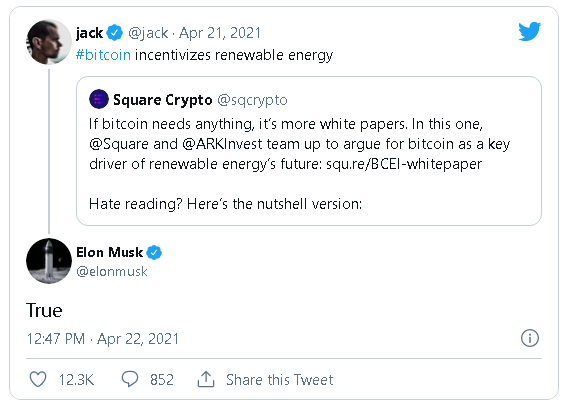
Billionaire Elon Musk agreed with this view, retweeting Jack Dorsey’s post as a Bitcoin supporter. Tesla even accepted Bitcoin as payment for electric cars and invested $1.5 billion in Bitcoin as a reserve asset.
But just one month later, Elon Musk did a complete turnaround. Tesla announced it would no longer accept Bitcoin for car purchases, citing the cryptocurrency’s massive energy consumption and environmental damage.
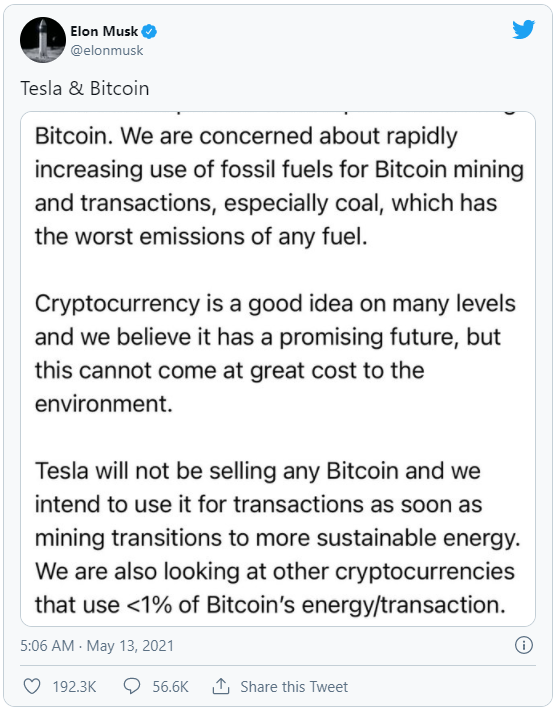
Elon Musk also revealed plans to look for another cryptocurrency that uses fewer resources than Bitcoin. Following this announcement, the crypto market plunged, with Bitcoin’s value dropping over 17% in just one day.
It’s unclear what motivated Musk’s sudden shift, but it highlights his rapid flip-flop on Bitcoin support. If Bitcoin truly harms the environment, Tesla shouldn’t have backed it in the first place, since the electric car maker’s mission is to protect the planet with clean energy.
Bitcoin’s high energy consumption has been known for a long time. Earlier this year, researchers at Cambridge University estimated Bitcoin uses 121.36 terawatt-hours annually, more than the entire country of Argentina.
Beyond flip-flopping on Bitcoin, Elon Musk and Tesla also used Bitcoin to boost their latest financial report. By selling about 10% of Tesla’s Bitcoin holdings, Musk helped Tesla’s earnings per share (EPS) beat analyst expectations, pleasing investors.
The profit from selling Bitcoin even exceeded Tesla’s electric car sales profit in Q1 2021. Without it, Tesla’s earnings likely wouldn’t have met expectations, potentially upsetting investors.
Musk defended this move as a way to demonstrate Bitcoin’s liquidity to Tesla’s board. This action also contributed to the crypto market’s downturn in mid-April.
Source: cointelegraph

