

Posing with flowers in your mouth for selfies has become a huge trend on Chinese social media. There are countless posts showing bloggers how to hold flowers, placing them beside the face, covering the mouth, tucking behind the ear, or even holding them in the mouth. All just to get that perfect shot.
But media outlets like the South China Morning Post and China News reported on June 16 a case where a university student had to be rushed to the hospital after biting into a poisonous flower.
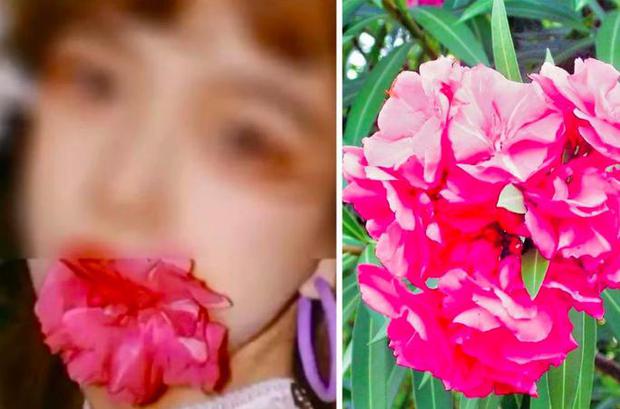
The student, from Zhengzhou city in Henan province, was taking selfies with roadside flowers. She posed like a muse with the flower in her mouth. Later at home, she felt dizzy and lightheaded but didn’t think much of it, assuming she was just tired. Overnight, her condition worsened with nonstop vomiting and diarrhea.
Recognizing signs of poisoning, her family rushed her to the emergency room. Thanks to timely medical care, she survived and is now recovering, though her poisoning was severe.
Doctors confirmed she was poisoned by oleander sap after biting the flower. Health experts warn that all parts of the oleander plant, leaves, flowers, stems, and bark, are highly toxic and can cause serious illness or death.
On Xiaohongshu, China’s popular social media and e-commerce platform, many women have shared stories of oleander poisoning after putting the flower in their mouths for photos.
One user wrote, “I started feeling strange and dizzy while taking pictures. I thought it was just weakness. Luckily, I quickly spit the flower out because of its taste. That probably saved my life.”

Oleander is sometimes called “dangerously beautiful.” It’s one of the most toxic plants, with every part containing poison.
Among oleander’s toxins, some compounds can be deadly, especially to children. Reports show that even a small amount can be fatal. Some sources say eating 10-20 leaves can be life-threatening for adults, while just one leaf can kill a child.
Symptoms of oleander poisoning include nerve paralysis, nausea, diarrhea, stomach pain, irregular heartbeat, poor circulation, muscle weakness, and in severe cases, coma or death if not treated quickly. The sap can also cause skin irritation, swelling, and severe eye damage that may lead to blindness.
Ton Yen, an employee at Zhengzhou Botanical Garden, explained that oleander’s toxins can harm the digestive and cardiovascular systems. She warned, “Oleander releases a milky sap, and people should avoid touching it.”
“The poison causes stomach reactions like nausea, vomiting, electrolyte imbalance, and muscle weakness,” said Dr. Wang Hengyu from Zhengzhou People’s University Hospital. He added that “it can still lead to death.”

