

The clash between Apple and Facebook over privacy policies has shaken the digital economy, forcing countless companies to shift billions in ad spending and limiting user data access for advertisers.
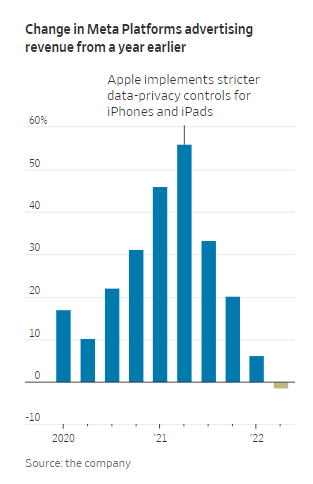
In 2021, Apple fired the first shot by launching iOS 14.5, a version that lets iPhone and iPad users easily block Facebook ads. Specifically, Apple introduced a feature that lets users control how third-party apps like Facebook collect their data.
This move cost Facebook billions in revenue and sparked unprecedented tension between the two tech giants.
But few know that before the battle began, Apple had actually proposed sharing the massive ad revenue from Facebook, which was rejected. This refusal was the main reason Apple decided to strike first.
The Proposal for Partnership
According to the Wall Street Journal (WSJ), Apple offered a deal years before the conflict, aiming to share part of Facebook’s ad revenue. Sources told WSJ that Apple wanted to “build a business alliance with Facebook.”
One idea was to create an ad-free version of Facebook. Since Apple charges fees on its App Store, a paid, ad-free Facebook app could benefit both companies.
Apple also wanted to enter the boosted posts market, where users pay Facebook to promote their posts. WSJ sources said Apple proposed turning this service into an app so Apple could take a 30% cut of the sales. This was unusual since Apple rarely shares revenue from advertising activities.
Facebook rejected these demands, unwilling to share its lucrative ad income. CEO Mark Zuckerberg even delayed data updates to avoid hurting ad growth.
In response, Apple took a hard stance in 2021 by launching App Tracking Transparency (ATT), letting users control data tracking.
Insider Intelligence found only about 37% of iPhone and iPad users allow third-party data tracking, causing a major disruption in advertising. Reports from Tenjin and Growth FullStack in June 2022 showed 59% of mobile ad budgets in the UK and US shifted from Apple’s iOS to Google’s Android.
Meanwhile, Lotame estimated Apple’s changes would cost Facebook, Twitter, Snap, and YouTube up to $17.8 billion in revenue in 2022.
Facebook alone lost $600 billion in market value in less than a year. Last month, Meta reported its first-ever quarterly revenue decline since going public in 2012.
From Allies to Adversaries
WSJ reports Apple and Facebook were once close allies, with Facebook’s apps like Instagram, Messenger, and WhatsApp dominating the App Store.
But despite Facebook’s apps being the most downloaded, they didn’t generate matching revenue since they were mostly free. This frustrated Apple’s management, who earned no fees from these downloads.
Worse, Apple saw its iPhone sales decline for the first time in 2016, pushing CEO Tim Cook to shift focus from hardware to software.
By 2017, Apple leaders promised to double software revenue by 2020.
As predicted, Apple’s latest quarter showed hardware revenue at $63.4 billion, down 1% year-over-year due to weaker PC and tablet sales. Meanwhile, revenue from ads, cloud services, and the App Store hit $19.6 billion, up 12% from last year.
A huge part of Apple’s income comes from a secret deal with Alphabet (Google), revealed only in 2020. Google pays Apple billions annually to be the default search engine on Safari.

This example shows Apple wants Facebook to pay a fair share for the value iPhone users bring to the social network, especially as Apple’s hardware sales growth slows.
WSJ says Apple’s power is shaking the entire online ad industry with new privacy rules. Sources say Facebook even considered building a paid, ad-free version on the App Store to share profits and ease tensions.
But Facebook rejected this again, unwilling to risk its huge ad revenue. Meanwhile, Mark Zuckerberg is pivoting toward the metaverse to find new growth paths beyond these constraints.
*Source: WSJ

