

According to Smithsonian magazine (part of the world’s largest research institution, the Smithsonian Institution under the U.S. government), 17-year-old Robert Sansone from Fort Pierce, Florida, is a “natural engineer.” He has invented everything from an electronic glove to high-speed running shoes and a go-kart that can reach speeds over 113 km/h.
This “inventor” estimates he has completed at least 60 engineering projects in his free time outside of school.
A few years ago, Sansone watched a video about the pros and cons of electric cars. The video explained that most electric car motors require magnets made from rare-earth elements, which are expensive and environmentally damaging to extract. These rare-earth materials can cost hundreds of dollars per kilogram, while copper costs only $7.83 per kilogram.
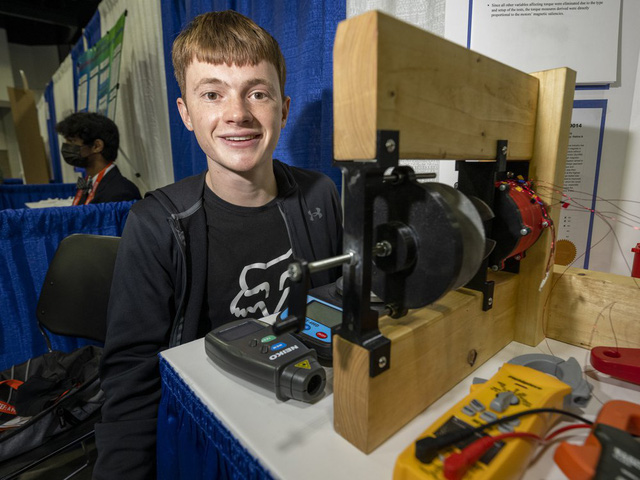
“I’m passionate about electric motors. I wanted to try designing a different kind of motor that uses copper,” Sansone shared.
In household appliances, there is a type of copper-core electric motor that creates a rotating magnetic field without using rare-earth materials. These motors are used in pumps and fans but aren’t powerful enough for electric vehicles. So Sansone started brainstorming ways to improve their performance.
Over the course of a year, Sansone developed a copper-core electric motor that produces a rotating magnetic field with higher efficiency than existing motors. The prototype was made from 3D-printed plastic, copper wire, and a steel rotor. It was tested using various meters to measure power output and a laser speed sensor to determine the motor’s rotation speed.
Sansone’s design includes other components, but he can’t reveal more details yet as he hopes to secure a patent for the technology in the future.
His invention won first place and a $75,000 prize at the 2022 Regeneron International Science and Engineering Fair (ISEF), the largest high school STEM competition in the world.
Sansone is waiting for the next phase of testing before approaching car manufacturers. He hopes that one day his motor design will be chosen for electric vehicles.
As a senior at Fort Pierce Central High School, Sansone dreams of attending the Massachusetts Institute of Technology (MIT). He plans to use his ISEF prize money to help pay for college tuition.
Heath Hofmann, a professor of electrical and computer engineering with years of experience working on electric vehicles, including consulting for Tesla on motor control algorithms, praised Sansone’s efforts. However, he noted that electric motors are complex and notoriously difficult to manufacture, which could be a challenge for Sansone’s invention.
Sansone agrees but says, “With new technologies like 3D printing, it will be easier to build new motors in the future.”

