

The 8.8x Price Shock and Gamers’ Struggle
If you thought $1,300 was the sweet spot for a solid AAA gaming PC like in 2023-2024, think again. By March 2026, Vietnam’s PC hardware market is facing a serious crisis. RAM sticks that used to be a minor cost have suddenly become the biggest barrier to getting your dream graphics card.
1. RAM: From Budget Add-On to Budget Killer
The global AI boom has drained DRAM supplies. Giants like Samsung and SK Hynix are focusing all production on HBM memory for servers, leaving the mainstream PC market behind.
Harsh reality: Checking prices at An Phat or KCCShop today, a 16GB DDR4 Kingston Fury Beast kit, once a national favorite, now costs 5,000,000 VND (about $210).
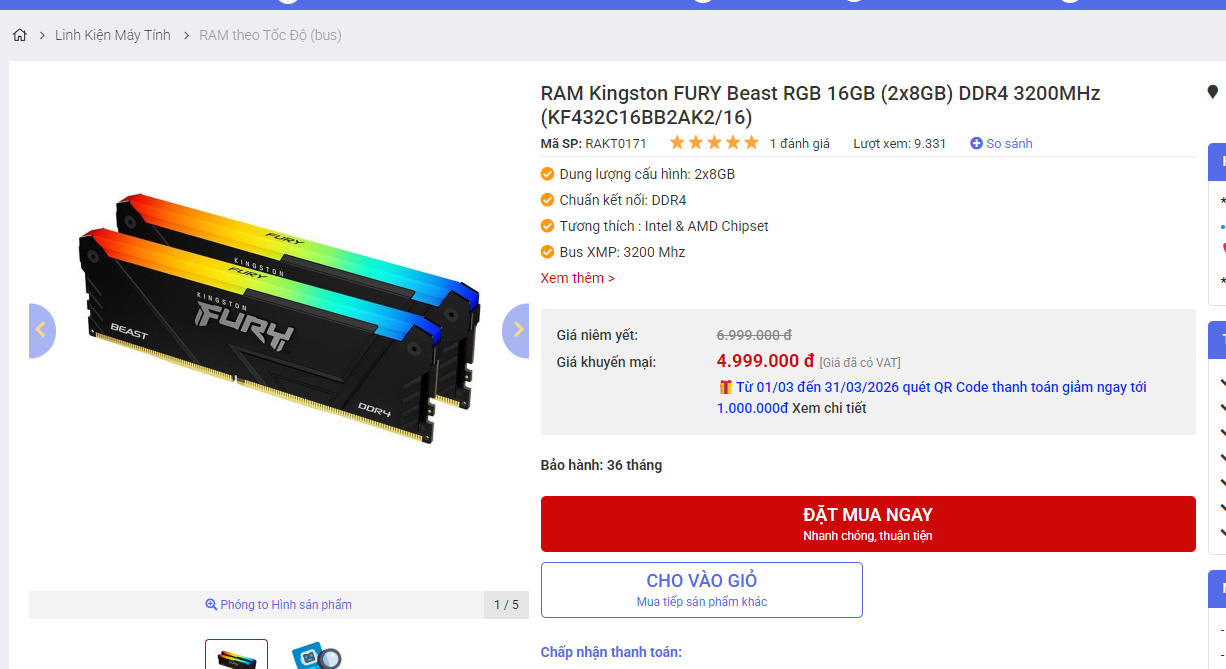
Impact: RAM alone now eats up one-sixth of a 30 million VND budget. This is unprecedented in Vietnam’s DIY PC history.
2. SSD: The Never-Ending Nightmare
NAND flash prices aren’t spared either. With a roughly 246% increase compared to last year, a decent 1TB NVMe Gen4 SSD now costs between 3.5 to 4 million VND ($150-$170). You can’t skimp on unknown brands if you want stability, but official prices are painfully high.
3. GPU: Making Do with What’s Left
This is where the real struggle begins. After spending nearly 10 million VND on RAM and SSD, plus another 10-12 million on CPU, motherboard, PSU, cooler, and case, gamers are left with just 8-10 million VND for a graphics card.
Trade-off: With this budget, the best you can get is an RTX 4060 8GB, a card that used to cost 15-20 million VND last year.
Pain point: Want smooth 2K gaming on an RTX 4070 Super? You’ll need to add at least another 8-10 million VND. The 30 million VND build now only covers entry-level 1080p gaming.

Hard-Won Advice:
In the middle of the March 2026 price storm, if you’re still set on building a brand-new PC with 30 million VND, be ready for a rig that looks powerful on paper but underperforms in real gaming.
Tip: Don’t hesitate to buy second-hand (like-new) parts like RAM or cases to save money for a better GPU. Or simply be patient and wait until Q2 2026 when supply is expected to stabilize.

