

In 1996, Herbert Fingarette was 75 years old. Like a dark premonition, the American philosopher wrote a book titled “Death: I’m Waiting for It from a Philosophical Perspective.”
In this book, Fingarette argued that all fears about death are irrational. “Death is the end,” he wrote. Why should we be afraid when we ourselves will no longer exist to experience death or fear it?
But more than 20 years later, at age 97 and facing his own death, the philosopher realized he was wrong. Death began to scare Fingarette, haunting his mind and making it impossible to stop thinking about it.
Ironically, Fingarette spent over 40 years teaching philosophy at the University of California and wrote extensively about self-deception. Now, at the final threshold of life, he wondered if he was deceiving himself about the meaning of life and death.
“It haunts me, the thought that I am about to die, whether for a good reason or not,” Fingarette said in the short documentary “At 97” by Andrew Hasse. “I often walk around asking myself: What is the meaning of this whole life?”
Hasse is Fingarette’s grandson, who filmed his grandfather’s final days. They had been very close since Hasse was a child. Fingarette used to tell stories and record them on tapes to send to Hasse, who lived 300 miles away.
So even from afar, Hasse could listen to his grandfather’s bedtime stories. “My grandfather was one of the most thoughtful men I’ve ever met,” Hasse said.
“At 97” is a profound film exploring the inner world of old age and the struggle to accept the inevitable. Hasse quietly observed what defined his grandfather’s existence: silence, loss of mobility, and acceptance that he now needed help.
“It’s hard for those who haven’t reached old age to understand the mindset, what’s happening inside their bodies and minds,” Fingarette said.
In one scene, Fingarette listens to a song he once shared with his late wife. He hadn’t heard it since she passed away seven years earlier. Her death was a huge loss, leaving him feeling empty, lonely, and “half dead.”
“Her absence is now a presence to me,” Fingarette said in the film as grief seemed to swallow him whole.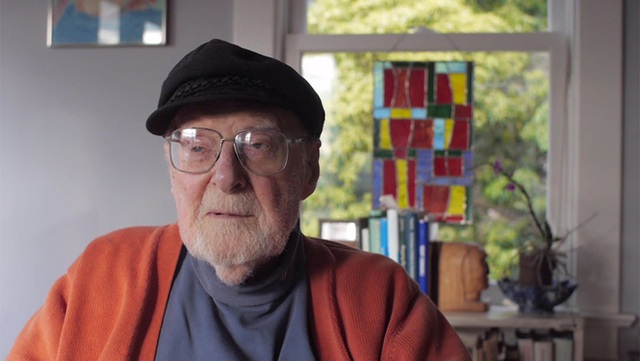
Hasse chose an artistic approach by removing his own voice from the film. So while filming this scene, he had to hold back the urge to comfort his grandfather. Hasse said, “It’s so hard to watch anyone in that kind of pain without being able to comfort them, especially someone you love deeply.
I was just sitting a few steps away, but couldn’t reach out because the camera was between us. All I wanted was to put my hand on his shoulder, hug him, and be there with him in that pain.”
After what felt like an endless take, the filmmaker handed his grandfather a tissue to wipe his tears. In the film, the shot ends just before this happens.
Fingarette also cried over small, everyday things. One moment was when he watched trees sway in the wind outside his porch. He realized their magical beauty, even though he had seen them his whole life.
Only this time, the trees moved him deeply. They brought him into a transcendent reality, an intense desire to live. “I think that’s how all our lives are,” Fingarette said. Life is full of ups and downs, happiness and pain. “Yet I still want to keep living.”
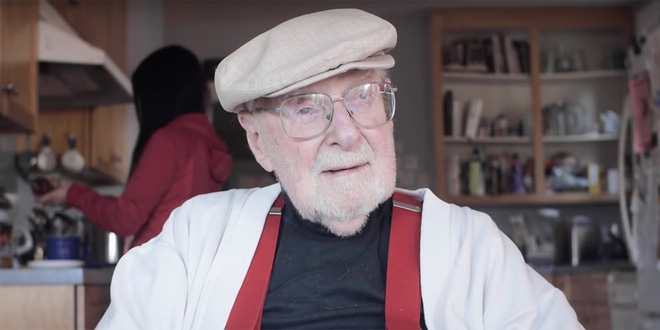
Fingarette passed away at the end of 2018 at age 97. Just weeks before, Hasse showed him the final cut of the documentary. “I think it helped him see what he had been through,” he said.
One day before he died, Fingarette spoke his last words. Hasse was there to witness it. After hours of silence with his eyes closed, his grandfather suddenly looked up and said, “Well, that’s clear now!”
Hasse isn’t sure what his grandfather meant. “But I want to believe he figured out something beyond death,” he said.
Source: Atlantic

