

Earth has existed for 4.6 billion years, and by that scale, human life on Earth is still very brief. Homo species appeared just 2.5 million years ago, and Homo sapiens, our direct ancestors, have barely evolved in the last 200,000 years.

Over the past four billion years, life on Earth has been endless. Yet today, there are only about 10 million species alive, which is just 1% of all species that have ever lived here. The other 99% have vanished over Earth’s long timeline.
Even though our planet is vibrant, it’s tough for any species to survive long-term on Earth. Over time, Earth’s climate keeps changing, and many ancient species couldn’t adapt, leading to their extinction.
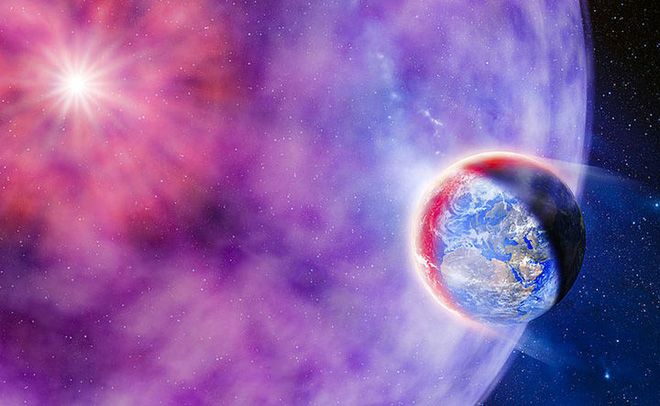
Life on Earth also faces deadly threats from space. For example, gamma-ray bursts from supernovae can destroy Earth’s atmosphere, exposing the surface to lethal cosmic radiation. Most life wouldn’t survive such an event. About 450 million years ago, a supernova likely caused one of Earth’s first mass extinctions. Similarly, a giant asteroid impact can trigger drastic climate changes, disrupt food chains, and cause mass die-offs. The fifth mass extinction 65 million years ago is believed to have been caused by such an impact.
Beyond space threats, Earth could harbor superbugs resistant to human defenses. Humanity also possesses nuclear weapons capable of wiping out all life on Earth. While we have the intelligence to create such powerful weapons, it’s uncertain if we have the wisdom to avoid large-scale nuclear war.

For many reasons, Hawking believed that to survive long-term, humanity must expand beyond Earth. By taking precautions and leaving Earth before disaster strikes, colonizing other planets offers a better chance to face unknown threats.
So, which planets should humans migrate to? Is there a “second Earth” out there?
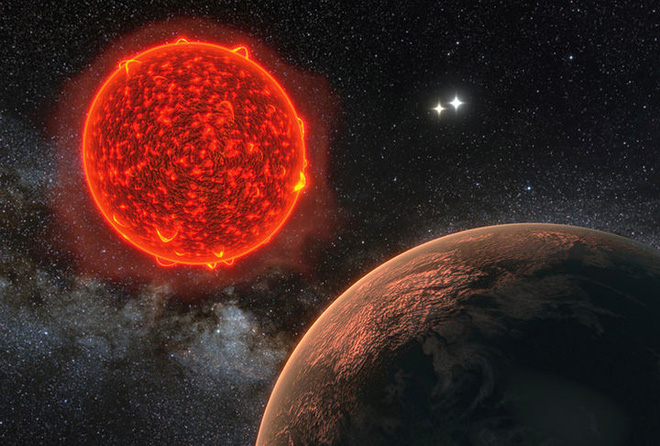
The star hosting Proxima b is Proxima Centauri, part of a curious triple star system still under study. The other two stars form a binary pair called Alpha Centauri. Although this “second Earth” shares some traits with our planet, Proxima b remains a mysterious and alien world.
Within our solar system, while some moons might support life, no planet besides Earth is suitable for human survival. To achieve space colonization, we must look beyond our familiar solar neighborhood.
Current data shows most star systems have planets, and with hundreds of billions of stars in the Milky Way, there are plenty of options. Humans need to target rocky planets in the habitable zone, where the distance from their star allows liquid water to exist on the surface.
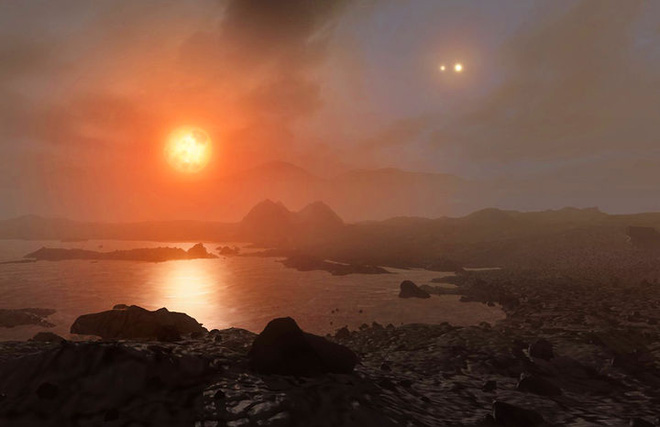
Proxima b lies right in the habitable zone of its star, where liquid water could exist. Compared to our sun, Proxima Centauri’s habitable zone is much closer to the star. Scientists once doubted red dwarfs like Proxima could host life-bearing planets because these planets orbit so close. Now, many believe red dwarfs might be the best places to find habitable worlds.
Recently, astronomers discovered Proxima Centauri, the star nearest to our solar system, has a planet called Proxima Centauri b. This rocky planet is Earth-sized and located in the habitable zone.
Although Proxima b is the closest exoplanet to our solar system at just 4.2 light-years away, humans currently lack the technology to reach it. Even with our fastest spacecraft, it would take tens of thousands of years to get there. Still, humanity has never backed down from challenges. We crossed oceans and now explore distant stars, so it’s very possible we’ll set foot on Proxima b someday.

