

The Earth is getting hotter every year. The past seven years might be the hottest in human history. Since 1850-1900, greenhouse gas emissions from human activities have raised the planet’s average temperature by about 1.1 degrees Celsius. What we’re experiencing now is truly alarming, with extreme weather events like prolonged droughts, heavy storms, hurricanes, and devastating floods. Natural disasters have become harsher and more destructive than ever.
But fixing climate change isn’t simple and can’t be done overnight. A few years or even decades aren’t enough to see positive results. To make sure efforts to save the Earth and the environment are on the right track, we need to see the future clearly and predict what’s coming with the highest accuracy.
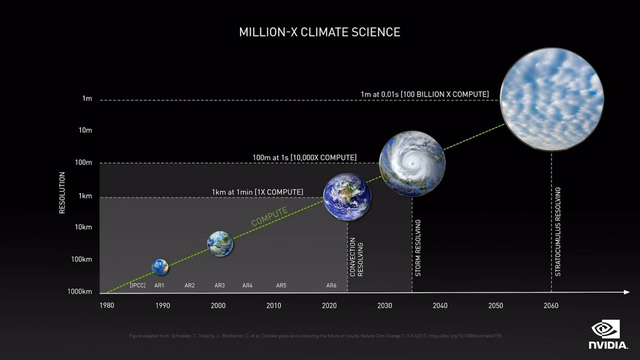
It might sound like science fiction, but this is exactly what NVIDIA is working on. At the GTC event in mid-November, they revealed Earth-2 (E-2), the world’s most powerful AI supercomputer, a “digital twin” of our planet built on the Omniverse platform. This 3D Earth simulator can make more accurate predictions about climate change.
According to CEO Jensen Huang, E-2 combines three advanced technologies: high-speed GPUs, deep learning, and AI supercomputing, along with a massive Earth database. Together, these create ultra-high-resolution, highly accurate climate models.
Many models like E-2 already exist, capable of measuring factors like air pressure, wind intensity, and temperature to create equations that objectively represent climate patterns in specific areas. These areas are displayed as 3D grids. The smaller the area, the more precise the data, and the more realistic the simulation, until it becomes too complex to use.
In other words, weather models need to solve more equations to achieve higher resolution. But handling more equations slows the model down, making it less efficient and eventually unusable. This is the main problem most climate models face today: they lack both detail and accuracy.
NVIDIA’s solution is a bigger, better, faster supercomputer. On the company blog, Huang wrote, “We need higher resolution to simulate changes in the global water cycle. We need meter-scale resolution to model how sunlight reflects off clouds back into space. Scientists estimate that this level of resolution requires computing power millions to billions of times greater than what we have today.”
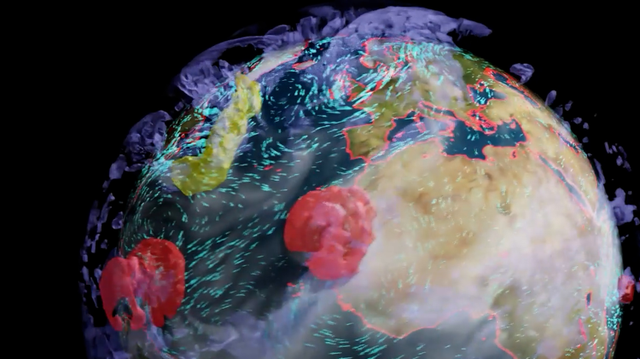
Back to E-2, this digital twin of Earth is designed to drive actions that both ease climate change and reduce its harmful effects on nature and people. Extreme weather like storms, wildfires, heatwaves, and flash floods are becoming more unpredictable and destructive.
This situation could improve if we can predict such disasters more accurately in the future. Huang hopes NVIDIA’s model can forecast extreme weather changes decades ahead in many regions worldwide. That would give people time to prepare, create evacuation plans, or build infrastructure suited to those climate conditions.
E-2 will also help find practical solutions by simulating various plans to identify the most effective and cost-efficient options. This is one of NVIDIA’s biggest projects in years. Huang said, “All the technologies we’ve developed so far are essential to making E-2 a reality. I’m really excited about the new features and important tasks this model will take on in the future.”
Not just about climate change
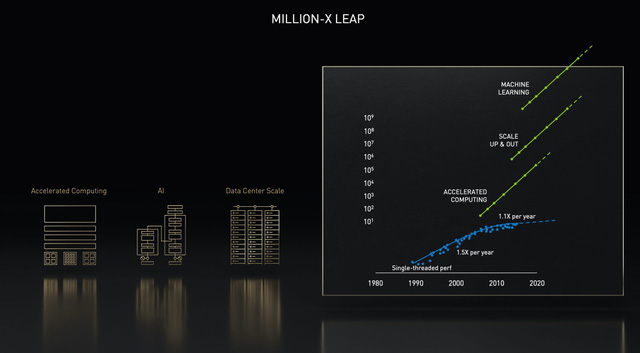
Combining multiple technologies has allowed NVIDIA to create the most advanced and efficient Earth simulator, while also tackling supercomputer speed challenges, especially in projects with huge data sets.
Like E-2, NVIDIA focuses on three core technologies: high-performance computing, AI, and large-scale data centers. This not only lets them simulate Earth but also create digital twins of cities and factories worldwide. This large-scale simulation tech is still new and full of potential.
Additionally, NVIDIA researchers teamed up with Caltech and startup Entos to combine machine learning with physics to build OrbNet. This lets Entos speed up drug discovery simulations by 1000 times, completing work that used to take over three months in just about three hours.
Source: VentureBeat, NVIDIA

