

B1257+12 is a star system with three planets, at least one of which is suspected to have a mass close to Earth’s. These three planets orbit the parent star B1257+12 and were the first exoplanets (planets outside our Solar System) ever confirmed by humans back in 1992.
As science has discovered more exoplanets, the uniqueness of B1257+12 has gradually come to light. The way these planets exist is very unusual: B1257+12 is actually a pulsar, a type of extremely powerful neutron star.
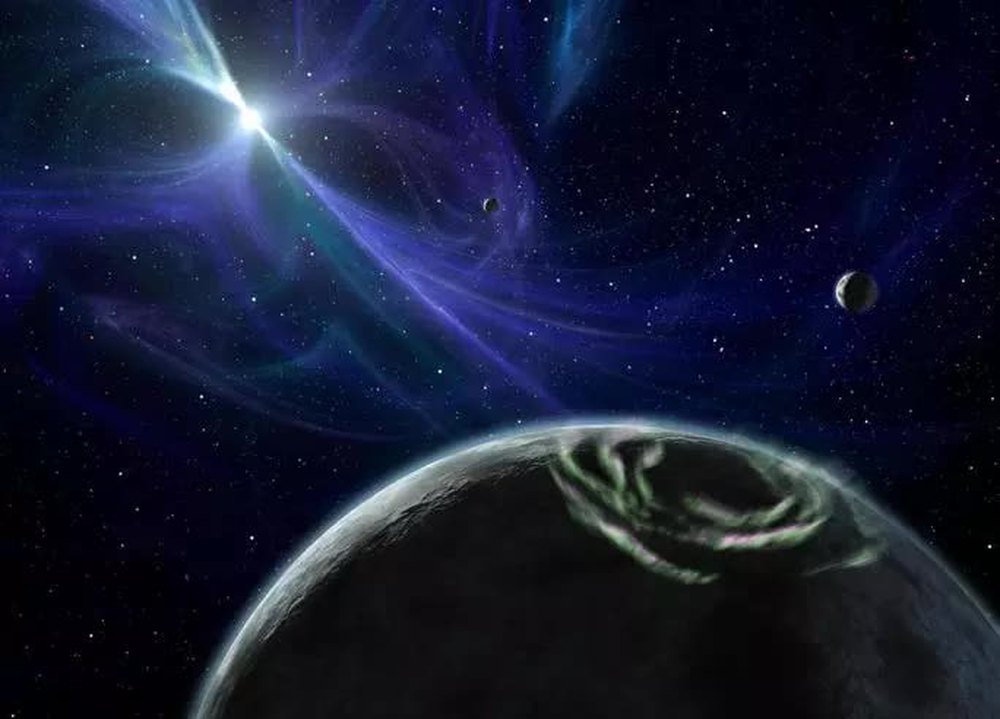
Neutron stars belong to the “otherworldly” category: they are dead remnants of giant stars that exploded and collapsed into tiny, dense objects. To this day, scientists still can’t fully explain how planets can survive such a supernova explosion or form afterward around a neutron star.
According to SciTech Daily, the value of the discovery made 30 years ago has been upgraded by new research led by the University of Manchester in the UK.
Surveying over 800 pulsars, researchers found that systems like B1257+12 are extremely rare. The chance of an Earth-mass planet forming around a pulsar is only about 0.5%, and one of the three planets in this system might even be smaller, with a mass comparable to the Moon.
These planets are treasures in the literal sense: they are rocky like Earth, but because they orbit a pulsar, they couldn’t have formed in the usual way. Instead, they are mostly made of diamond.
The massive dataset of over 800 pulsars from the Jodrell Bank Observatory that Manchester scientists studied also revealed a series of other strange pulsar systems. Some have planets with masses 100 times that of Earth, orbiting anywhere from 20 days to 17 years. Most of these planets have elongated elliptical orbits, unlike the nearly circular orbits of planets in our Solar System.
From these 800 pulsar systems, scientists narrowed down 10 promising candidates that could open the door to unimaginable “otherworldly” planets.
Among them, they are paying special attention to a system named PSR J2007+3120, which may host at least two rocky planets several times more massive than Earth, with orbital periods between 1.9 and 3.6 years.

