

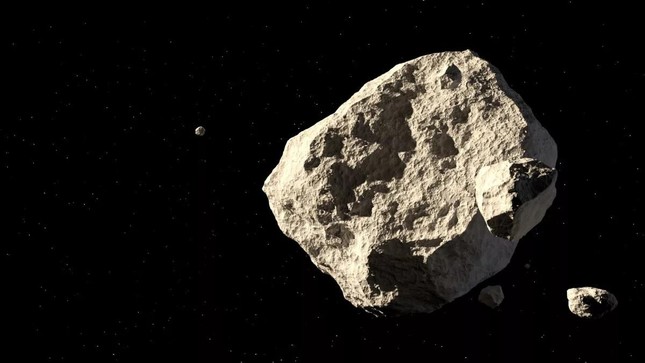
At its closest approach, the asteroid, traveling at 27 times the speed of sound, will come within about 4.3 million kilometers of Earth, more than 8 times the average distance between Earth and the Moon. By space standards, that’s considered a close call.
NASA classifies any space object passing within 193 million kilometers of Earth as a “near-Earth object,” and any fast-moving object within 7.5 million kilometers is labeled “potentially hazardous.”
Once flagged, astronomers closely monitor these objects for any unexpected changes in their predicted paths, like a collision with another asteroid, that could cause a catastrophic impact with Earth.
NASA has tracked about 28,000 asteroids, mapped through the Asteroid Terrestrial-impact Last Alert System (ATLAS), a network of four telescopes capable of scanning the entire night sky every 24 hours.
Since going online in 2017, ATLAS has discovered over 700 near-Earth asteroids and 66 comets. Two of these asteroids, 2019 MO and 2018 LA, actually hit Earth, one exploded off Puerto Rico’s southern coast, and the other landed near the Botswana-South Africa border. Luckily, both were small and caused no damage.
NASA has projected the orbits of all known near-Earth objects through the end of this century and reassures us that Earth faces no asteroid impact threat for at least the next 100 years.
But that doesn’t mean space watchers are taking a break. Recent history shows asteroid impacts can still be destructive, so vigilance continues.
For example, in March 2021, a bowling ball-sized meteor exploded over Vermont with the force of 200 kg of TNT. That event was unrelated to the more powerful meteor explosion near Chelyabinsk, Russia, in 2013.
When the Chelyabinsk meteor hit the atmosphere, it unleashed an explosion equivalent to 400 to 500 kilotons of TNT, 26 to 33 times the energy of the Hiroshima bomb. Fireballs rained down on the city and surrounding areas, damaging buildings, shattering windows, and injuring about 1,200 people.
According to Live Science

